


M33 Installation Package Not Supported
13.10.2019
We are doing 'network installation' for Office 2010. We have already done this for English & Slovenian Language pack. We wanted to add another proofing tool (Serbian). I have downloaded: srofficelanguagepack2010x86dvd575374.iso.First I have opened ISO with magicdisc and copy all the content over already prepeared network installation office 2010.I have changed the config.xml in ProPlus.WW folder. I have added the bold text: After I run the setup.bat: 'c: Office 2010-test install setup.exe' /config 'C: Office 2010-test install ProPlus.WW config.xml' I receive an error: The Language of this installation package is not supported by your system.
Ok, I googled some pages and saw, that maybe this can be related due to extracting the proofing tool, sth with directory/structure not being extracted the way tha MS wants it. I have opened ISO with magicdisc and copy the folder content (no luck, error the same).
Error 'This installation package is not supported by this processor type. Contact your product vendor.' Error when installing.
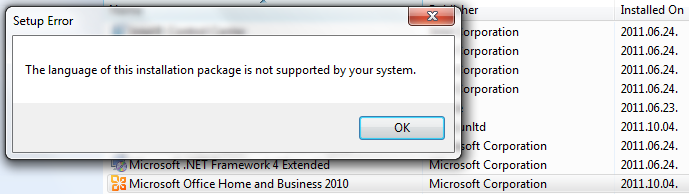
Then I have used WINRAR for extracting ISO, but the error still remains the same. Let me mention that for test purpouse I'm doing Upgrade of Office 2007 to Office 2010, cause this is the most real scenario in our company. I have also googled a page where it says I must Uncomment this: but that also did not do any good. Any sugestions please? I think my question is very similiar what Christopher Woods CustomMade is asking as the last post on this thread:. What would be the right procedure to extract ISO.etc bostjanc. Download flatout 2 ps2.
Hi, thank you for your feedback. The langague code I provided is from the list of 'Language identifiers and OptionState Id values in Office 2010' at and should be the correct one. Maybe you could add the following line to enable logging: After starting the setup you will find the logfile in 'c: Office 2010-test. At the top of the log (among the first thirty lines) setup will document what it parsed and which languages were identified.
If you are not familiar with the logging of office 2010 you can also post the logfile here. But I have another question: In your first post you stated 'we want to add proffing tools (serbian)'. The -statement will add a whole lanugage pack including a localized display language. If you want to add proofing tools only (without display language), you should refer to and add an Optionstate-statement to you config.xml like the following one: and remove the addlanguage-statement. Please remember to click “Mark as Answer” on the post that helps you, and to click “Unmark as Answer” if a marked post does not actually answer your question.
This can be beneficial to other community members reading the thread. I have added the recommended command (look the bold text). The installation went thru. But in the end there is no proofing tool instaled. Only Slovenian and English US if I look under options - language on client.
Driver Easy to install the proper and correct driver for your processor type. When installing a driver on your Windows PC/laptop, you may see this error message: this installation package is not supported by this processor type, despite the driver package fits with your Windows operating system and processor type. Don’t be confused! This article introduces two simple methods to solve your problem. Method 1: Method 2: Why does this problem occur? Previously, you can successfully install the driver package when the Windows OS and processor type are as defined by the driver manufacturers.
However, starting from 2016, Microsoft made changes to its update strategies. The change is in the format of TargetOSVersion decoration, an entry in. This format defines the installation information to install the driver package, such as the OS versions and the product types. Starting with Windows 10, version 1607 (Build 14310 and later), the format adds a new part in the INF file: the BuildNumber part.
That means that it started to define the build number of the Windows version when installing the drivers. Soon after, Intel has started to adopt this new technique and also add the BuildNumber part into the installation information. That is to say, If the build number of your Windows version doesn’t fit with the defined BuildNumber part of the package by the driver manufacturers, you will fail to install the driver package, despite the correct Windows version and processor type.
How to Check the Build Number in your Windows Tips: If you want to check whether the build number in your Windows fits with the one defined by the driver manufacturer, follow these instructions: Check your computer’s build number and other system information via Command Prompt: 1) Type cmd in the search box, and right click Command Prompt to Run as administrator. Then click Yes. 2) Type systeminfo and press Enter. Then you will see your build number as below: Then check the defined build number in the driver package (take Intel graphics driver for Windows 10 64 bit as an example): 1) the zip file from the Intel downloading website.
2) Open the downloaded file, and click the Graphics folder. 3) Find a file with.inf extension name and open it. 4) Check the Manufacturer part in the file, and you will see defined build number. As you can see 14393 in the BuildNumber part, this driver package supports to download on Windows 14393 and later. If the build number of your Windows is not 14393 and later, you can’t install this graphics driver in your computer. Method 1: Update your Windows version You can update your Windows 10 to the latest version to solve this problem. In doing that, your build number is always the latest.
While installing the driver, you don’t need to worry whether your build number is correct or not. Follow these instructions to update: 1) Click the Settings button in the Start menu. 2) Click Update & security. 3) Click Check for updates to scan for the latest update, then your Windows will automatically download the updates. 4) Click Restart Now to restart your PC/laptop and finish the update. 5) Try to install the driver again to see if it works.
Method 2: Automatically update your drivers There are two ways to download and install the drivers in your Windows. Option 1 – Manually: You can manually download and install the drivers in your Windows. You may need to find the correct drivers on the website, check if the build number defined by the driver installation package match with the build number in your Windows (you can click to know how to check the build number), and then download it in your Windows.
That may require time and computer skills. Option 2 – Automatically (Recommended): If you don’t have time or skills to find and install the drivers manually, you can do it automatically with. With Driver Easy, you don’t need to know the exactly build number of your computer, and you don’t need to risk installing the wrong driver. Furthermore, it supports the new scan technique in Windows 10. This will help you find more accurate scan results. You can update your drivers automatically with either the FREE or the Pro version of Driver Easy.
But with the Pro version it takes just 2 clicks (and you get full support and a 30-day money back guarantee): 1) and install Driver Easy. 2) Run Driver Easy and click Scan Now. Driver Easy will then scan your computer and detect any problem drivers. 3) Click the Update button next to a flagged driver to automatically install the correct driver (you can do this with the FREE version). Or click Update All to automatically download the correct version of all the drivers that are missing or outdated on your system (this requires the – you’ll be prompted to upgrade when you click Update All).
Language Installation Package Not Supported
4) Restart your Windows and you will have the latest and correct drivers in your Windows. Hope these methods can help you fix the error. If you problem still persists, feel free to let us know and we will see what more we can do to further help.