


Dx7 Patches Download
17.09.2019
This is a sweet find. From in the 1987 Keyboard Magazine interview with Brian Eno. We have four different DX7 Mk I (brownie) patches from the ambient master himself.
Wouldn’t it be nice to load the classic Yamaha DX-7 patches into your Kronos? Well you can and here’s how (source: the Kronos Parameter Guide): Loading DX sounds Overview The MOD‐7 can load sounds created for the vintage DX7. There are thousands of these sounds available on the internet, providing a massive pre‐existing library of timbres (in addition to the many sounds created exclusively for the MOD‐7!). Try searching for “DX7 SysEx download.” Once loaded, you can bring these vintage sounds up to date using all of the MOD‐7’s unique features, layer them with other EXi, and process them with KARMA and the KRONOS effects. The conversion works by reading.SYX format System Exclusive files.
This format is supported by programs on all major computer operating systems. Supported file types In order to load a file, it must meet the following requirements:. The file must contain a complete bank of 32 DX7 sounds.
Files with only a single sound cannot be loaded. The file may contain multiple System Exclusive messages, but only if the main DX7 bank dump is the first of these messages.
All subsequent messages in the file will be ignored. Note: some instruments, such as the DX7II, may transmit multiple System Exclusive messages when doing their program data dump, with the main DX7 bank dump coming last. If this set of messages is stored into a single.SYX file, the KRONOS will not be able to load the file. The System Exclusive must be in the original, first‐ generation DX7 format, which was supported by all of the classic 6‐operator FM synths as well as the DX9. System Exclusive files from later‐generation FM instruments, such as 4‐operator “baby DX” synths and the TX81Z, SY77, etc., cannot be loaded. Loading a single bank of DX7 sounds To load a bank of DX7 sounds: 1.
Transfer the DX7.SYX file to KRONOS‐readable media, such as a USB flash drive. Connect the media to the KRONOS. Press the front‐panel DISK button to enter Disk mode. Go to the Load page. In the Drive Select parameter, select the media from step 2, above.
Select the DX7.SYX file. Press the LOAD button. A dialog box will appear, allowing you to select a bank into which to load the sounds. Since DX7 banks contain 32 sounds, while a KRONOS bank contains 128, you can also select where to place the DX7 sounds within the KRONOS bank: into Programs 0‐31, 32‐63, 64‐95, or 96‐127. Select the bank and Program range into which to load the sounds. Important: If you select an HD‐1 bank, it will be changed to an EXi bank, and all of the banks’s HD‐1 Programs will be erased. Press OK to load the sounds.
The sounds will be loaded into the KRONOS as MOD‐ 7 Programs. Loading multiple banks of DX7 sounds If you like, you can load multiple.SYX files at once. Follow steps 1 through 4 under “Loading a single bank of DX7 sounds,” above. Enable the Multiple Select check‐box.
Select the desired DX7.SYX files. Press the LOAD button. An “Are you sure?” dialog will appear.
For each.SYX file, select the bank and Program range to load into. For more information, see steps 8 and 9 under “Loading a single bank of DX7 sounds,” above. Error messages If the KRONOS can’t read the file, it will show one of two error messages: There is no readable data will appear if the file is shorter than 4104 bytes, or if the SysEx header indicates something other than DX7 Program Bank format. File contains unsupported data will appear if the header is correct, but the data is damaged; for instance, if the fileʹs checksum doesnʹt match, or if the trailing F7 is missing. Velocity response Converted sounds will respond to MIDI velocity in the same way as did the original instruments. In other words, if you play both the original and converted sounds from an external MIDI controller, they should sound the same.
However, the local keyboards on some of the original DX instruments were not capable of producing very high velocities; instead, they might max out around 105 or so. The KRONOS’s keyboard, on the other hand, can produce velocities over the full MIDI range, up to 127. This means that some sounds may be brighter when played from the KRONOS’s keyboard, as compared to the original instrument’s keyboard. If you like, you can use the Brightness Vel. Parameter to reduce the velocity sensitivity to taste.
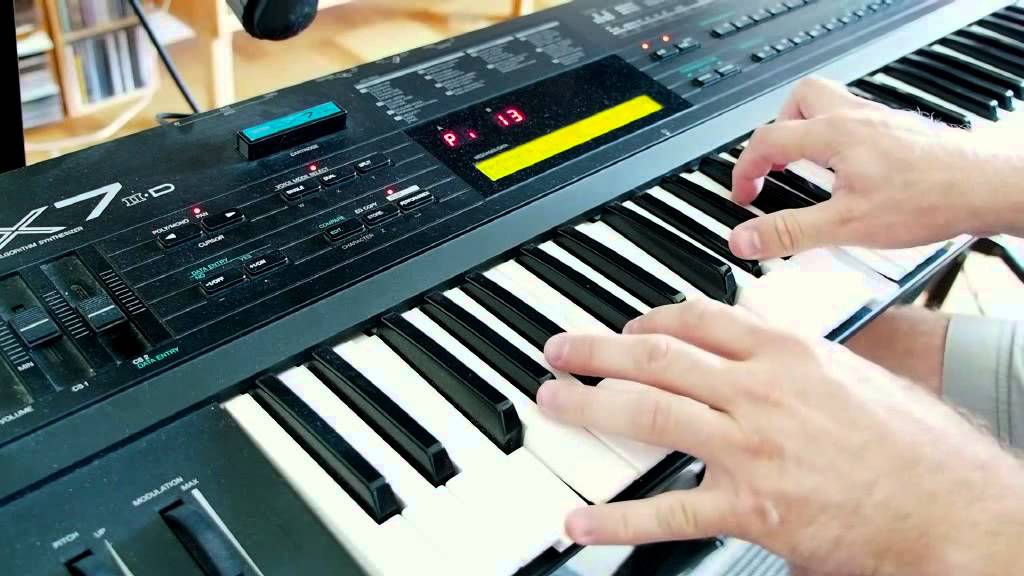

Where to find DX-7 patches? Here you can find 200.000 patches 🙂.
5 / 5 I've had the original DX7, then got myself a DX7 II-s (I modded it with the Grey Matter Response E! Board, anyone remember that?), and finally an SY-77 just because it had 'real' pianos for gigs. I still have the latter two. This is the closest I've heard to the real thing. Not exactly identical, but 1) remember the velocity issue - all Yamaha keyboards at the time were limited to around 105 max velocity. Maybe the plugin could use an option to map 0-127 to 0-105 or whatever the limit was?
This would make some patches less squeaky/harsh. 2) This plugin only emulates the digital circuits that performed FM. The sound of the hardware synth also has D/A converters and preamps. These add some noise, distortion, 'grit', 'magic' or 'mojo', whatever you want to call it. I haven't tried, but I guess that if you really want a phylologically perfect emulation, it would only require: a) limiting the velocities by some clever DAW remapping, b) inserting a couple of plugins after dexed's output: add some noise, maybe add bit reduction to 12 bit (if it isn't 12 bit already) and a (little) bit of preamp simulation (but no tube preamps, guys!).
5 / 5 Some of the people on here have no idea of the beauty of FM. I own a real DX7 and this is the nearest I've heard to the real synth. I love the sound of FM it is my favorite type of synthesis. I also have FM8 and this is soooo much better than FM8 in my opinion. There is nothing wrong with the GUI at all.
I've been looking for a good DX7 editor librarian and this is a dream come true. Thank you so much. You have made me very happy.
Some of the people complaining here haven't got a clue about FM. Don't listen to them. This is well worth the download. 5 / 5 Holy crap we live in permanent science fiction.
We have the sum total of human knowledge in the palm of our hands. We can never get lost or bored. And now I can download a tiny bit of code for free and suddenly I have a DX7 synth that is far superior to the original. How is it superior you ask?
Have you ever tried to program the original DX7? We all gave up and just pressed for the next patch. It was a nightmare. This positively begs for tweaking.
It's superbly designed and sounds great. Does it sound exactly like a DX7? Well which DX7 do you want to compare it to, since they all sounded a little different. This is close enough and when you integrate it into a track it does exactly what we used them for all those years ago. To cut through everything else and stand out front in the mix.
I can't recommend this enough and Digital Suburban should get the Nobel Prize for coolness. BTW to people like 'thefixer' and 'POS Master' all I can say is 'WOW really?' I dare you to try and do half of what this guy has done. He didn't even go down the old Synthedit route. He coded this all from scratch and produced an excellent tight synth for those of us who remember what it was really like in the glorious 'Analog' days. 3 / 5 Great for free. Some cool features that no other freeware fm synth has.
Yamaha Dx7 Patches
The GUI is slick, astheticly pleasing, and nicely laid out, all on one page, thats what I like:), but. I'm guessing the GUI was designed more with the app, than the vst in mind, its cramped, and yet only uses 1/4 of the screen. Make it bigger. It would be nice if you could manipulate the graphic displays too. The biggest problem is the sound quality. The operators have really audiable pitch steps, even the fine tuning, there are problems with envelopes with short release times too. The overall sound quality is pretty poor in comparison to commercial fm vst's.
A valiant effort, but sound quality is everything. Thanks for sharing this, I had fun playing with it, your definitley on the right lines,I'll definitly be checking out the next version, but there's still a lot of work to be done before this is a viable alternative to the FM vstis I use. Richard Jan 20 2015 Lulz i crack up reading that. So it is an exact recreation of a classic fm synth sound.
Can you not read that again and realise how idiotic you sound (comparing the DX7 to commercial synths that feature fm). Have you perhaps also thought you might need to learn about applying effects to the signal? 0 / 5 I agree with 'thefixer' you might be able to make some sounds if it weren't for that wretched gui with it's tiny unmarked knobs and no way of knowing the signal paths. Maybe if you had severe autism this might make sense! Oh yeah you also have to load C runtimes on your computer to run it!
Dx7 Patches Free Download
It claims to be a DX7 styled synth. Programing an actual DX7 would be easier than this convoluted mess! Anonymous Jun 23 2014 I guess FM synthesis is too difficult for you to handle! Richard Jan 20 2015 The original is like that though, sort of like a modelling synth you expect to find weird sounds, it would never be a goto performance synth where you want to tweak dials on the fly as small changes cause radical sound alteration. Ableton operator is like that.