


Vyatta Virtualization Iso Vmware Workstation Torrent
23.09.2019
Jul 21, 2012 Install in VMware Workstation for VC6.4 - 64 Bit Virtualization iso Download file: vyatta-livecd-virt_VC6.4-2012.05.31_amd64.iso for http://vyatta.org.
In this tutorial I will show one method of routing between multiple virtual host-only networks in VMware Workstation 8. This can be useful for simulating a large multi-site network in a lab environment at little cost. In order to do so, we will be using Vyatta vee-ah-tah Network OS and simulating the following simple 3 site network. Step 1 -Create Virtual Networks This tutorial assumes you already have your VM’s created, so we will jump right to the networking.In the VMware Virtual Network Editor, create an interface for each virtual network you wish to simulate and route. For my example, I will need 2 interfaces for each site. One for the LAN interface and one for the WAN interface.Edit Virtual Network Editor Add Network.
I have setup my virtual networks as follows. Step 2 – Create Vyatta VM I will be using Vyatta 6.2 and working from the CLI (command line interface) and also showing you how to enable the GUI web interface. Vyatta 6.3 is the latest distribution since posting and now requires you to have a paid subscription to access the web interface. If the web interface does not interest you, use the latest version.Once you have downloaded the Vyatta LiveCD, you will need to create a new VM.Open VMware File New Virtual Machine Typical configuration select the Vyatta ISO as the Installer Disc Image Vyatta is Debian based Linux OS, Debian 6 works fine for Guest OS Give a name and location for the VM 2GB disk space is enough for Vyatta Choose “Customize Hardware” You need only give Vyatta 512MB of RAM Finish -Now you will need to install the Vyatta OS. Once the CLI finishes loading, log in with the default credentials.
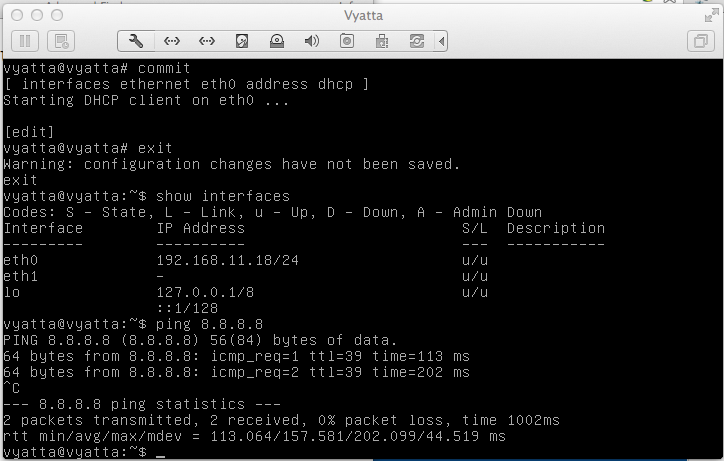
Username: vyatta Password: vyatta (Note: the password will not show as you type).Type ‘install-system’ and press enter (no quotes) to start install process.Type ‘Y” to continue install.Vyatta will scan the drives and ask how you would like to create the required root partition. I will choose ‘Auto’.If you only have one drive, choose the recommended one. In my case ‘sda’.It will warn you any existing data on the drive will be lost of you continue. Since I have nothing on this drive I will enter ‘Y’.You will then be asked how big of a root partition you want to create.
I will only be using this drive for Vyatta, so will allocate all available space.Choose to copy the recommended configuration files to the drive. The path is provided in the brackets.You will then be prompted to change the default Vyatta admin password. You will need to remember this in order to log in to the CLI or web interface.Select which drive for the GRUB boot loader.Once the GRUB is configured, we will want to shutdown the VM so the virtual interfaces can be added.
To shutdown, simply type ‘shutdown’ and hit enter. Vyatta will confirm that you want to do so, choose Yes. Step 3 – Configure the Routers -With the Vyatta VM shutdown, you will want to add all the interfaces it will be routing. Remember, in this tutorial I am simulating 3 physical routers.
I will need to add the LAN and WAN interface for each router. – Before powering on the Vyatta VM, make sure you have disconnected the Vyatta ISO disc -Power on Vyatta and log in using the admin password you set during installation. The user name should still be vyatta.Issue a ‘show interfaces’ command and you should see all attached interfaces.In order to make any configurations, you must enter configuration mode. To do so, simply enter ‘configure’.Now you can configure each router.
First assign an IP address to each interface. I will assign mine as follows eth0 192.168.2.2/24 Site 1 LAN eth1 74.100.2.2/16 Site 1 WAN eth2 192.168.3.2/24 Site 2 LAN eth3 75.100.3.2/16 Site 2 WAN eth4 192.168.4.2/24 Site 3 LAN eth5 76.100.4.2/16 Site 3 WAN -To assign an IP to an interface: set interfaces ethernet eth0 address 192.168.2.2/24 -Assign the proper IP for the remaining interfaces. If you wish, you can also enter a description for the interface: set interfaces ethernet eth0 description “Site 1 LAN” -After you have configured any IP and descriptions you need, you must issue a ‘commit’ command and a ‘save’ command. If you are done making configurations, enter ‘exit’ to leave configuration mode.You can issue another ‘Show interfaces’ command to make sure all the configurations you made are correct. The last step is to implement a routing protocol. I will use RIP since the hop limitation does not matter in this scenario. Make sure you are back in configuration mode.Advertise interface: set protocols rip interface eth0 (issue this command for each interface) -Redistribute the connected routes: set protocols rip redistribute connected -Commit and save changes.
Step 4 – Test Routing configuration At this point you should be able to configure the NIC’s on your other VM’s. Make sure to assign a proper NIC and default gateway to each VM. For example, Server1 in the diagram above will be assigned to VMNet0 and have a default gateway of 192.168.2.2. Once you have the VM’s properly configured you should be able to ping any server at another “site”.
If you are having trouble pinging another server, make sure you are allowing ICMP through the firewall or just disable it. If you wish to make configuration changes from the Vyatta Web Interface, you must enabled HTTPS. This protocol is disabled by default.In configuration mode issue the following command: set service https -Commit and save the change. You should be able to access the Web Gui from any router interface. Hint: use https and try to enter the IP without /vyatta on URL.
Posted by on Mar 15 2015 (updated on Nov 24 2016) in. May 08 2015 Update - The detailed video is finally, with very handy chapter markers! This new video was recorded on April 19th, and was edited down to about 1 hour 20 minutes. It's a detailed step-by-step video, geared toward those who want nice hostnames in a home lab. If you want a simpler approach, choose this earlier, shorter. It demonstrates the easier IPs (rather than host names) procedure.

Also note that we're all still waiting to see what happens with 365 day licenses for vSphere 6.0 home labs under, I inquired again on May 7, 2015 with an contact. Aug 24 2015 Update - The 6.0.0b versions of ESXi and VCSA are now out, but the installation instructions don't change. Also note that EVALExperience worked out fine for vSphere 6.0 users, detailed here:. Sep 26 2015 Update - The versions of ESXi and VCSA are now out, and as far as I can tell, the installation instructions still work, this is good! Nov 24 2016 Update - Status of vSphere 6.5 update to this artice appears.
Original article below: See below, to help you understand the prerequisites. I'm working hard on the full recipe for success, to build up your vSphere 6.0 home lab. The focus of this article is on fresh installs, but you can read all about more complicated upgrade options and. Note, while I say fresh install, that doesn't mean you are starting from scratch, if you have existing VMs.
Those can easily be added back into your inventory, once you get your vSphere 6.0 environment set up, and any additional drivers you may need for networking and storage. Overall, vSphere 6.0 is an easier install, once you get to know your way around some of the newness of it all. Installing ESXi 6.0 is much the same as it's been for years, but the VCSA (VMware vCenter Server Appliance) is different, and easier, basically consisting of these 3 steps:. double-click to mount the VMware-VCSA-all-6.0.0-2562643.iso file (Windows 8 or later). install the vcsa VMware-ClientIntegrationPlugin-6.0.0.exe. run vcsa-setup.html to launch your browser, which begins the install wizard for VCSA This recipe for all the ingredients you'll need for your own awesome home lab setup will be soup-to-nuts thorough, with a focus on simplicity, ease of deployment, and ease of use.
Once you see the video, it's all so much more straightforward than all the documentation implies. Topics will include:. slick ways to make login easier. FQDN ( Fully Qualified Domain Names) instead of ugly IP addresses. create shortcut for your vSphere Web Client on your Taskbar, with no URL or menus cluttering up the top of your valuable browser real estate What I'm trying to do is get past VCSA's dislike for using DHCP (which is simplest in a home lab to use for that first install), using a custom procedure for renaming the appliance after the initial install, and after the initial deployment. Alternatively, I may just go with the method.
One barrier has been lack of valid documentation this early on. For example, here's a VMware document that hasn't yet been updated since the 5.5 days. See for yourself, visit this article, then simply change the vsphere-60 in the URL to vsphere-55, and it still comes up. Yep, that ain't right, they simply haven't updated it for 6.0 yet. The main page, the, currently shows last updated March 12 2015.
But you don't have to wait until I have the recipe fully documented, and the solution fully baked. Especially if you're just messing around and plan to rebuild from scratch. Keep reading!
all sections below are currently a work in progress The procedure is demonstrated in this rough-cut earlier video, from an earlier build, but it's the same install/configure procedure, if you're ok with going with IP addresses instead of host names. My revised completely new video includes install, and configure, with a twist. I added tweaks so you have a nice looking vSphere Web Client with a FQDN (Fully Qualified Domain Names) for ESXi and VCSA, instead of merely using IP addresses. Yes, it's all about that home network WiFi router, which doesn't do the forward and reverse lookups that VMware expects (in the datacenter).
The work arounds are fairly straight-forward, but not as easy as I would have liked. Here it is, the detailed, step-by-step video that gets you an awesome home virtualization lab, with lovely names like esxi and vcenter, rather than ugly IPs. Want chapter markers, to jump ahead to just the right spot in the video? Well, the video is intended to be followed from start to finish, but I realize it's still awfully handy to figure out where you left off by having all the chapters nicely laid out for you.
Disclaimer Emphasis is on home test labs, not production environments. No free technical support is implied or promised, and all best-effort advice volunteered by the author or commenters are on a use-at-your-own risk basis. Properly caring for your data is your responsibility. TinkerTry bears no responsibility for data loss. It is up to you to follow all local laws and software EULAs.
Privacy Policy Please review the TinkerTry. Copyright Short excerpts of up to 150 words may be used without prior authorization if the source is clearly indicated. This means you must include both the original TinkerTry author's name, and a direct link to the source article at TinkerTry. © 2011-2018 TinkerTry.com, LLC all rights reserved.
Disclosure TinkerTry.com, LLC is an independent site, has no sponsored posts, and all ads are run through 3rd party BuySellAds. All editorial content is controlled by the author, not the advertisers or affiliates. All equipment and software is purchased for long-term productive use, with any rare exceptions clearly noted.
Affiliate Link Disclosure TinkerTry.com, LLC is a participant in the, an affiliate advertising program designed to provide a means for TinkerTry to earn fees by linking to Amazon.com and affiliated sites. These revenues help show your support by helping fund the production of quality content, at no cost to you.
Other shopping links featured in the articles may be from Skimlinks, Digital River/OneNetworkDirect, or Commision Junction affiliate programs, and could also result in small commissions for purchases. Many content creators will find Skimlinks a convenient way to commoditize high-value content, with little effort.
Vmware
See also and. If you're interested in automatic Skimlinks to help cover the cost of running your site, consider using this.